I know reaching out for help can feel scary. Maybe you're wondering if your situation is serious enough, or what actually happens when you call one of these numbers.
Here's what I want you to know about crisis support:
- 988 connects you instantly – In the US, just dial 988 and you'll talk to a trained counselor in under a minute. It's that simple.
- Texting feels safer for many people – Crisis Text Line (741741) lets you get help through text messages. What surprised me most? 66% of people share something they've never told anyone else.
- There's specialized help for your specific situation – Whether you're a veteran, LGBTQ+ youth, or dealing with disaster trauma, there are people who truly understand what you're going through.
- You don't have to be “bad enough” to call – Here's something that might shock you: 80% of callers aren't even expressing suicidal thoughts. Any emotional distress counts.
- Your privacy stays protected – You control what you share, you can stay anonymous, and no one will judge you or tell you what to do.
Studies show that 80% of people say follow-up calls helped keep them safe. Most callers feel less overwhelmed and more hopeful after talking with a counselor. These services exist for moments exactly like yours – whether it's 2 AM loneliness, relationship problems, or feeling completely overwhelmed.
If you're reading this and hesitating about reaching out, that hesitation itself tells me you could use some support.
I get it – calling a suicide hotline when you're struggling takes real courage. You might feel scared or wonder if it will actually help. Here's what the research shows: 80% of people say follow-up calls from crisis hotlines helped keep them safe. When you contact a suicide crisis hotline, trained counselors provide immediate support through collaborative de-escalation, helping reduce your immediate risk. These services exist specifically for moments like this. Let me walk you through 10 accessible options that are available 24/7.
988 Suicide & Crisis Lifeline (United States)
Image Source: Joint Base San Antonio
What This National Suicide Hotline Offers
If you're in the US and need someone to talk to right now, 988 is probably the easiest number to remember. They launched this three-digit number in July 2022 to replace that long 1-800-273-8255 number that nobody could ever remember when they actually needed it.
When you dial 988, you're connecting to a network of over 200 local crisis centers across the United States and its territories. What I love about this service is that it's completely free and confidential – no matter what you're going through. Whether you're having thoughts of suicide, dealing with mental health struggles, substance use concerns, or just feeling completely overwhelmed by life, they're there for you.
Here's something that might surprise you: since 988 launched, they've answered over 13 million calls, texts, and chats from people who needed support. That's a lot of people reaching out, which tells me you're definitely not alone in whatever you're facing.
Studies show that most people who talk to a 988 counselor feel less suicidal, less depressed, less overwhelmed, and more hopeful after their conversation. That gives me hope, and I think it should give you hope too.
Here's something really important to know: over 90% of people who attempt suicide go on to live out their lives. That means getting through this crisis moment really can change everything.
The service offers support in English and Spanish, and they provide interpretation in more than 240 languages at no cost to you. If you're a veteran, you can press 1 for specialized support, and they even have videophone services if you're deaf or hard of hearing.
Who Can Call This Crisis Hotline Number
Anyone. Seriously, anyone.
You don't need to be in immediate danger or have some official diagnosis. I know sometimes we talk ourselves out of calling because we think our problems aren't “serious enough.” But if you're dealing with relationship troubles, loneliness, anxiety, depression, trauma, bullying, or you just need someone to listen without judging you, the 988 Lifeline is there.
You can call for yourself, or if you're worried about someone you care about.
Your conversations stay completely confidential. They won't ask for payment or insurance information. They won't ask about your immigration status, and here's something I really appreciate – you don't have to answer questions that make you uncomfortable.
How to Access the Service
It's really straightforward. You have three options: call 988, text 988, or chat online at 988lifeline.org.
When you call, you'll hear a greeting with some menu options. Press 1 if you're a veteran, press 2 for Spanish, or press 0 to skip the menu entirely. Your call gets routed to a local crisis center near you.
For texting, just send any message to 988. You'll get some prompts with instructions. Veterans can text 838255 directly, and if you need Spanish-speaking counselors, text AYUDA. The chat services work in both English and Spanish.
What Happens When You Call
Here's what actually happens when you reach out – and I think this might help if you're nervous about calling.
Usually, a counselor answers in under a minute. You might hear some music while you're connecting, which is totally normal. When someone picks up, they'll introduce themselves, ask about your safety, and then really listen to understand what's going on with you.
They won't judge you or tell you what to do. Instead, they'll help you work through what you're feeling, share resources that might help, and work with you to figure out solutions that feel right for your situation.
Your identity stays private throughout the whole conversation. They can't share what you talk about unless someone's life is in immediate danger.
Crisis Text Line (United States, Canada, UK)
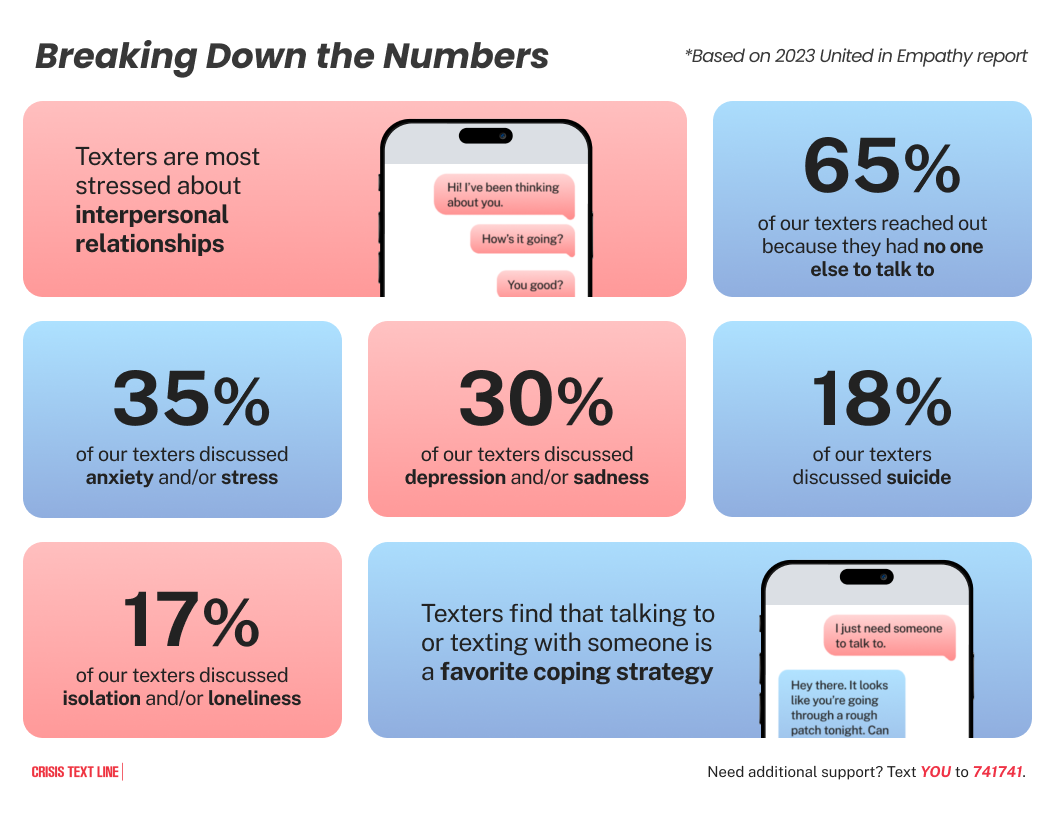
Image Source: Crisis Text Line
What This Crisis Service Offers
I know for me, sometimes picking up the phone feels impossible. Maybe you're in a crowded room, or your anxiety makes it hard to speak out loud, or you just feel more comfortable typing out your thoughts. That's exactly why Crisis Text Line exists.
Crisis Text Line launched in 2013 as a global nonprofit providing free, confidential text-based mental health support. The service now operates throughout the United States, Canada, the UK, and Ireland, offering immediate crisis intervention 24 hours a day.
Here's what makes this different: the service has handled over 10 million conversations with people facing mental health challenges. Every Crisis Counselor receives 30 hours of training before they start supporting people through stress, anxiety, loneliness, bullying, substance use, self-harm, and suicidal thoughts. Clinical supervisors with master's degrees monitor every conversation in real-time, so you're getting professional-level support.
Texting works really well for crisis counseling. In fact, 66% of people who reach out share something with their counselor they've never told anyone else. There's something about typing that makes it easier to be honest. The platform uses a smart system to prioritize people who need help most urgently, and those at highest risk connect with a counselor in just 13 seconds on average.
Who Can Reach Out
Anyone experiencing any type of crisis can use this suicide crisis hotline. Whether you're stressed, anxious, lonely, or having thoughts of self-harm, trained volunteers listen without judgment.
You might hesitate because your situation doesn't feel “serious enough,” but here's the thing: if it's a crisis to you, it's a crisis to them.
Texting gives you privacy that phone calls can't match. You can reach out from anywhere – a crowded classroom, your workplace, or lying awake in bed at 3 AM. Even better, you can text DELETE after any conversation to completely erase it from your phone.
How to Get Help
Text 741741 from anywhere in the United States to connect with a trained Crisis Counselor. Your opening message can say anything – “help,” “I'm struggling,” or even just “hi.” Keywords like HOME, START, HELLO, or CONNECT help them track how people find their services, but honestly, any message works.
You have other options too:
- WhatsApp at (443) SUP-PORT for English or (442) AYU-DAME for Spanish
- Webchat on their website
- Facebook Messenger (your information stays encrypted and anonymous)
What Actually Happens When You Text
You'll get a couple of quick automated messages while they connect you to a real person. Connection usually takes less than five minutes, though it might take longer during busy times.
Your counselor will introduce themselves, acknowledge what you've shared, and invite you to continue at your own pace. They'll ask about your safety, listen without judgment, and help you work through your feelings by asking questions and really listening.
Most conversations last 15 to 45 minutes. Your counselor's goal is to help bring you from that overwhelming moment to a calmer, safer place. When you both feel you've reached a comfortable state, the conversation ends.
Veterans Crisis Line (United States)

Image Source: Veterans Crisis Line
What This Service Offers Veterans
Military service changes you in ways that most people can't understand. The pressures, the experiences, the culture – it all stays with you long after you've served. That's exactly why the Veterans Crisis Line exists.
Since 2007, this specialized service has been there for veterans who understand what it's like to carry that weight. They've handled more than 8 million calls, over 975,000 chats, and nearly 400,000 texts. This isn't just another hotline – it's part of the 988 network, but run specifically by the U.S. Department of Veterans Affairs for people who've served.
Here's what makes this different: the people answering your call actually get it. Many of the VA responders are veterans themselves. They understand military culture, the brotherhood, the sense of duty, and the struggles that come with all of it.
A 2021 study found that most veterans who reached out said the service was helpful and kept them safe. Even better, veterans who called were 10 times more likely to connect with VA mental healthcare afterward.
They don't just help you in the moment and disappear. The Caring Letters program sends you supportive messages for a full year. There's also a Peer Support Outreach Call Center where trained veterans reach out to people who might need ongoing support. Veterans with peer mentors are more likely to keep their VA appointments and try additional treatments.
Who Can Reach Out
This service is for you if you're a veteran, active-duty, National Guard, or Reservist – or if you're worried about someone who is. Your family members and caregivers can call too when they need guidance on how to help.
You don't need to be enrolled in VA benefits to call. Your discharge status doesn't matter. Whether you're dealing with homelessness or at risk of losing your housing, support is available. Even friends and family members worried about a veteran can call for resources without the service reaching out to that person.
How to Get Help
Dial 988 and press 1 – that's it. You'll connect directly with a VA responder.
You can also text 838255 or chat online at VeteransCrisisLine.net/Chat. If you use TTY, just use your preferred relay service or dial 711, then 988.
What Actually Happens When You Call
After dialing 988 and pressing 1, you'll hear a brief message while you're being connected. Then a qualified VA responder will listen – really listen – to understand what's going on in your life right now.
They'll ask about your safety and whether you or someone you care about might be in immediate danger. Your conversation stays completely confidential, and you control how much you share.
The responder works with you to get through the crisis and helps create a safety plan that actually makes sense for your situation. They can connect you with resources from your local VA medical center or other community supports. If you want, your local suicide prevention coordinator will follow up with you the next business day.
You served your country. Now let your country serve you.
Lifeline Australia

Image Source: Lifeline
What This Crisis Hotline Provides
Sometimes you just need to talk to someone who understands. That's exactly what Lifeline Australia has been doing since 1963 – being there when people need them most.
Here's something that shows how much this service matters: more than one million calls come through each year, plus over 200,000 texts and chats. That's a lot of people reaching out when things feel overwhelming.
What I find really meaningful about Lifeline is that approximately 11,000 trained volunteers across 41 centers answer every single conversation. These aren't just operators reading from scripts – they're real people who genuinely care about what you're going through.
Lifeline provides confidential, one-to-one support through what they call a trauma-informed, person-centered approach. This isn't clinical therapy where someone analyzes you. Instead, it's a human-to-human connection for when you're in distress. Your trained Crisis Supporter listens deeply and creates a safe space where you can talk about your needs, worries, or concerns without anyone judging you.
Their vision? Creating an Australia free of suicide. That's a pretty powerful reason to exist.
Who Can Call This Number
Anyone in Australia experiencing emotional distress can contact this crisis hotline number, no matter who you are – your age, gender, ethnicity, religion, or sexual orientation doesn't matter.
You might be sitting there thinking, “Is my situation really serious enough to call?” I get it. But here's the thing – your feelings matter. Whether you're dealing with relationship breakdowns, loneliness, mental health concerns, thoughts of suicide, self-harm, substance use, or you simply need someone to listen, trained supporters are ready.
Your conversation stays completely confidential and anonymous if you want it to. You don't need to explain yourself or justify reaching out. And calling doesn't mean you're weak – actually, it shows real strength and self-awareness.
How to Access Support
You have three ways to connect with Lifeline: call 13 11 14, text 0477 13 11 14, or chat online through their website. All of these work 24 hours a day, seven days a week, anywhere in Australia.
I'll be honest – the telephone service gets a lot of calls, so you might be on hold for a bit. But every call gets answered. Someone will be there for you.
What Happens During Your Call
Your trained Crisis Supporter will listen without judgment and give you a safe space to talk about whatever is worrying you. They use something called the CARE Framework to assess risk and support your safety.
Working together with you, they'll explore your options for support and help you figure out the next steps that feel right for your situation. Your supporter will remind you of your strengths, help identify the supports you already have, and encourage coping strategies that work for you.
The goal is straightforward: first, help you manage any immediate threats to your safety, then open up pathways toward longer-term solutions.
Samaritans (United Kingdom and Ireland)
What Makes This Service Different
Have you ever felt like you just need someone to listen? That's exactly what Samaritans is all about.
Someone in the UK or Ireland reaches out to Samaritans every 10 seconds. Think about that for a second – that's how often someone like you decides they need support. This suicide crisis hotline has been there for over 60 years, run entirely by trained volunteers through more than 200 branches.
Here's something that might surprise you: only about 1 in 5 people who contact them are having suicidal thoughts. Nearly 80% of people calling aren't expressing suicidal feelings at all. So if you're sitting there wondering whether your problems are “serious enough,” let me tell you – they are.
Whether you're dealing with depression, loneliness, relationship troubles, money stress, or anything else that's weighing you down, volunteers are ready to listen without judgment. They won't tell you what to do or try to fix you. Sometimes we just need someone to hear us.
You can reach them in different ways too: phone calls, email support, text messaging, face-to-face visits, and even webchat. In 2014 alone, they handled [5.1 million requests](https://en.wikipedia.org/wiki/Samaritans_(charity) for help. That's a lot of people who decided to reach out.
Who Can Reach Out
Anyone in the UK or Ireland can contact Samaritans, no matter your age. Your situation doesn't need to feel “crisis-level” to matter.
What seems small to other people might feel overwhelming to you, and the volunteers get that. Relationship problems, grief, work stress, abuse, or just needing someone to listen – all of these are valid reasons to reach out.
Your conversations stay completely confidential. And here's something I find reassuring: when you call, your number doesn't even show up on their phones. You control how much you want to share, including your name.
How to Connect
Call 116 123 free from any phone – you don't need credit or anything. You can also email jo@samaritans.ie, text 087 260 9090 if you're in Ireland, or visit a branch for face-to-face support. They're testing webchat too, though it's currently limited to certain hours.
What Actually Happens
A volunteer answers with something simple like “Samaritans, can I help you?” They listen without judging and ask questions to help you explore what you're feeling. They won't lecture you or tell you what to do – you're still the expert on your own life.
If you feel uncomfortable at any point, you can hang up. That's totally okay.
Talk Suicide Canada
What This Crisis Hotline Offers
Canada launched 9-8-8 on November 30, 2023, and honestly, it's about time. Finally, there's an easy number to remember when you're struggling and can barely think straight. The Center for Addiction and Mental Health (CAMH) works with the Public Health Agency of Canada to make sure this service actually helps people in crisis.
Here's what I think is really smart about this: when you call or text 9-8-8, you connect with trained responders from 37 different crisis lines across the country, including Kids Help Phone and Hope for Wellness. They try to connect you with someone in your community when possible, which means the person on the other end understands what it's like where you live. The service works in both English and French, and they use approaches that won't make you feel judged or broken.
While they focus on suicide prevention, they won't turn you away if you're calling about something else. Support remains available 24 hours a day, 365 days a year. That means 2 AM on Christmas morning, if that's when you need someone.
Who This Is Really For
Anyone in Canada can call this number. I know you might be sitting there thinking, “But is my situation serious enough?” or “Maybe I should wait until it gets worse.” Those thoughts are completely normal, and they don't disqualify you from reaching out.
Whether you're having thoughts about suicide, worried sick about someone else, or just need to talk through emotions that feel too big to handle alone, there's someone ready to listen without making you feel stupid.
How to Reach Them
Call or text 9-8-8 from anywhere in Canada. It's that simple. Both ways get you to a real person who's trained to help. The service runs all day, every day, so whether you're having a breakdown at 2 AM or need support during your lunch break, someone will be there.
What Actually Happens When You Call
A trained responder picks up and listens to understand what's going on for you. Your conversation stays private, and you don't have to give your name if you don't want to. They're not going to lecture you or tell you what to do. They're there to listen, really listen, and help you work through whatever feels overwhelming right now. You're in control of the conversation and can hang up whenever you need to.
Lifeline Aotearoa (New Zealand)

Image Source: Mental Health Foundation
What This Suicide Hotline Number Offers
When I think about what makes a community truly caring, it's services like Lifeline Aotearoa that come to mind. They've been there for New Zealanders for over 60 years, and here's something that really stands out to me: this service runs entirely on public donations. No government funding at all.
That tells you something, doesn't it? People in New Zealand believe so strongly in having this lifeline available that they fund it themselves.
You've got two main numbers to choose from. Call 0800 LIFELINE (0800 543 354) to reach their community helpline, where highly trained counselors work from centers in Auckland and Christchurch. If you're specifically thinking about suicide or you're worried about someone who is, there's the Suicide Crisis Helpline at 0508 TAUTOKO (0508 828 865).
The numbers are pretty telling. They handle 7,000 to 8,000 calls every month and exchange around 20,000 texts. Every single day, about 17 people at high risk of self-harm or suicide reach out. You wouldn't be alone in needing this support.
Your conversations stay completely free and confidential.
Who Can Reach Out
Anyone in New Zealand who's struggling can contact this suicide hotline number. Your problems don't need to feel huge or life-threatening.
Maybe you're dealing with anxiety that's getting worse. Maybe you feel stuck in a relationship that's draining you. Maybe you're just having one of those days where everything feels impossible, and you can't shake the sadness.
The counselors listen without making you feel like you need to justify calling. If you're reading this and thinking “but my situation isn't that bad,” that's exactly the kind of thinking that keeps people from getting help when they need it.
How to Access Support
Three simple options: call 0800 543 354, text HELP to 4357, or dial the Suicide Crisis Helpline at 0508 828 865. All of them work 24 hours a day, every day of the year.
What Happens When You Contact Them
A trained counselor or volunteer will answer and actually listen to what's going on with you. They won't rush you or make you feel like you're taking up too much time.
They work with you to figure out what you're feeling and help you see what your next steps might look like. They're not going to tell you what you should do – that's your choice. But they'll help you think through your options.
Your name, your story, everything you share stays private.
Kids Helpline (Australia)

Image Source: Kids Helpline
What This Youth Crisis Hotline Provides
Do you ever feel like everything is falling apart at 2 AM when there's absolutely no one to talk to? You're not alone in that feeling.
Young people often struggle the most during late-night hours when other support isn't available. That's exactly why Kids Helpline exists. 70% of those who reach out to Kids Helpline do so outside normal working hours. It's Australia's only free, private, and confidential 24/7 phone and online counseling service specifically for children and young people aged 5 to 25.
Here's what I want you to know: university-qualified counselors respond to all kinds of concerns. Whether you're dealing with relationship problems, family drama, mental health struggles, self-harm thoughts, bullying, or suicidal thoughts, someone is there to listen.
The service handles some really serious stuff. 1 in 4 contacts involve mental health issues, while 1 in 6 involve suicide-related concerns. You can connect by calling 1800 55 1800 or through WebChat on their website. Both options are completely free on all mobiles, landlines, and public phones.
Who Can Use This Service
Any young person aged 5 to 25 in Australia can contact this youth crisis hotline for any reason. And I mean ANY reason.
Your situation doesn't need to feel catastrophic or life-threatening. Whether you're dealing with school stress, loneliness, relationship troubles, or thoughts of self-harm, trained counselors are ready to listen without judgment. No problem is too big or too small.
Sometimes we convince ourselves that our problems aren't “serious enough” to bother anyone. But if it's bothering you, it matters. Trust me on this.
How to Access the Helpline
Call 1800 55 1800 anytime from any phone. Seriously, anytime.
If you're more comfortable typing than talking (and I totally get that), WebChat operates 24/7 through kidshelpline.com.au. Just know that wait times can reach 40-50 minutes during busy evenings, so don't give up if there's a wait.
If you need support in languages other than English, call the Translating and Interpreting Service on 131 450 and ask them to connect you.
What Happens When You Call
You'll hear a brief recorded message explaining how Kids Helpline works, then you'll connect with a counselor who'll ask what you'd like to discuss. That's it. No interrogation, no judgment.
You can request a male or female counselor and even ask to speak with the same person on future calls. Conversations last anywhere from 5 to 50 minutes. Your identity stays completely private throughout, and you never need to provide your name.
Remember, reaching out when you're struggling shows strength, not weakness.
The Trevor Project (United States)

Image Source: PR Newswire
What This LGBTQ+ Crisis Hotline Offers
Being LGBTQ+ comes with its own set of challenges that can make you feel incredibly alone, especially when you're young.
I know what it's like to feel like you don't fit in anywhere. Maybe your family doesn't understand you, or you're dealing with bullying at school, or you're scared about coming out. These feelings can become overwhelming fast.
That's exactly why The Trevor Project exists. Founded in 1998, it became the first nationwide 24/7 crisis and suicide prevention helpline created specifically for LGBTQ youth. The counselors who answer understand the specific pressures you face – things like figuring out your sexual orientation, dealing with gender identity questions, facing family rejection, or handling discrimination.
In 2024 alone, the organization directly served more than 231,000 crisis contacts. That's a lot of young people who needed someone to talk to, and they found help.
Who This Service Supports
This suicide prevention hotline is for LGBTQ+ young people under 25 years of age.
Whether you're lesbian, gay, bisexual, transgender, queer, or still questioning – you belong here. If you're struggling with coming out, dealing with family who won't accept you, facing problems at school, or having thoughts of hurting yourself, this service was created specifically for you.
You don't need to have everything figured out about your identity. You don't need to be in an immediate crisis. If you're feeling lost or alone because of your LGBTQ+ experience, that's reason enough to reach out.
How to Access TrevorLifeline
You have three ways to connect:
Call 1-866-488-7386 anytime for phone support. Text START to 678678 for TrevorText, available 24/7 since 2019. You can also access TrevorChat at TheTrevorProject.org/Get-Help.
All options are completely free and confidential.
What Happens When You Reach Out
A trained counselor who understands LGBTQ+ experiences will answer. They listen without any judgment and provide support that affirms who you are.
Your conversation stays completely confidential. The counselor will help you work through whatever crisis you're facing right now while connecting you with resources that can support you in the long term.
Most importantly, you'll talk to someone who gets it. Someone who understands that being LGBTQ+ can feel isolating and scary, but also that you deserve support and acceptance exactly as you are.
Disaster Distress Helpline (United States)
Image Source: SAMHSA
What This Helpline Provides When Life Gets Turned Upside Down
When a disaster hits your community, the physical damage is only part of the story. The emotional aftermath can feel just as overwhelming, sometimes even more so.
Maybe you survived a hurricane and lost everything. Maybe you're a first responder who's seen too much. Or maybe you're watching the news about another mass shooting and feeling completely helpless and anxious.
The Disaster Distress Helpline exists specifically for moments like these. It's the first national hotline dedicated to providing year-round disaster crisis counseling, and honestly, I'm glad something like this exists.
This service stays available 24/7 to anyone in the United States and its territories who is struggling emotionally after natural or human-caused disasters. You'll connect with trained counselors who understand that disasters don't just damage buildings – they can shake you to your core.
These counselors don't just listen, though that's a huge part of it. They help you recognize how distress shows up in your life, connect you with local resources for follow-up care, and share practical coping strategies that actually work.
Who This Service Is Really For
If you're reading this and thinking, “Maybe this isn't for me,” let me stop you right there.
Anyone experiencing emotional distress related to disasters can reach this helpline. That includes you if you're a disaster survivor, but it also includes so many other people who get forgotten.
Are you worried about a loved one who went through something traumatic? You can call. Are you a first responder, rescue worker, or relief worker who's carrying the weight of what you've witnessed? This service is for you, too. Even clergy members and parents trying to help their kids process scary events – you all matter.
The disasters they support you through include the obvious ones, like tornadoes, hurricanes, floods, wildfires, and earthquakes. But they also understand the emotional impact of drought, mass violence, infectious disease outbreaks like COVID, and community unrest.
The bottom line? If a disaster – any kind of disaster – has left you feeling emotionally shaken, you deserve support.
How to Get Help
Call or text 1-800-985-5990. That's it.
One thing that really stands out to me is that counselors can connect you with support in over 100 languages through interpretation services. So language barriers don't have to keep you from getting help when you need it most.
What Actually Happens When You Reach Out
The counselors listen with patience and without judgment. You're not going to get lectured or made to feel like you should “just get over it.”
Here's something that might ease your mind: you don't need to provide identifying information. You can stay anonymous if that feels safer for you.
These are people who understand that disasters mess with your head in ways that are hard to explain to others. They get it, and they're there to help you work through whatever you're feeling.
Quick Guide: Which Support Feels Right for You?
Do you ever have moments where you're struggling but can't figure out who to call? Maybe you're lying awake at 2 AM, or sitting in your car after a difficult day, wondering if your situation is “serious enough” to reach out for help.
I want you to know something: if you're questioning whether to call, that's already reason enough.
Here's the thing – these services exist exactly for moments like yours. Whether you're dealing with anxiety, relationship troubles, work stress, or thoughts of self-harm, there's someone ready to listen without judgment.
Here's a simple breakdown to help you choose:
If you're in the US and need immediate support: Call or text 988. A counselor answers in under a minute, and over 13 million people have reached out. Most callers feel less overwhelmed after talking with someone.
If you prefer texting to talking, text 741741. It's anonymous, you can do it from anywhere (even a crowded room), and 66% of people share things they've never told anyone else.
If you're a veteran or active-duty military member, press 1 after dialing 988, or text 838255. The responders understand military culture, and many are veterans themselves.
If you're in Australia: Call 13 11 14. Over 11,000 trained volunteers are ready to listen, and you can remain completely anonymous.
If you're in the UK or Ireland: Call 116 123 free from any phone. Someone reaches out to Samaritans every 10 seconds, and 80% of callers aren't even expressing suicidal thoughts – any distress matters.
If you're in Canada: Call or text 9-8-8. A responder from your community will listen and help you work through whatever feels overwhelming.
If you're in New Zealand: Call 0800 543 354. The service handles thousands of calls monthly and operates entirely through community donations, showing how strongly people believe in providing this support.
If you're under 25 in Australia: Call 1800 55 1800. Kids Helpline exists specifically for young people, and 70% of contacts happen outside normal hours when you need support most.
If you're LGBTQ+ and under 25 in the US: Call 1-866-488-7386. The Trevor Project was the first nationwide crisis line specifically for LGBTQ+ youth and serves over 231,000 people annually.
If you're dealing with disaster-related stress in the US: Call 1-800-985-5990. Whether it's a natural disaster, pandemic stress, or community trauma, specialized counselors understand these unique challenges.
What Actually Happens When You Call
Your biggest worry is probably “What will they say to me?” or “What if I don't know what to say?”
Here's what actually happens: Someone answers who genuinely wants to help. They'll ask if you're safe, then they'll just listen. Really listen. You don't need to have it all figured out or explain yourself perfectly.
They won't judge you, lecture you, or tell you what to do. Most conversations last 15-45 minutes, and you can hang up anytime if you need to.
You control everything – your name, what you share, how long you talk.
If you're reading this right now and part of you is thinking about reaching out, please do it. These services exist specifically for moments like yours, and you deserve support just as much as anyone else.
What You Should Know Before You Call
Your hesitation? Totally normal.
I know you might be sitting there wondering if your situation is serious enough to warrant a call. Maybe you're worried about taking up someone's time or feeling like you should be able to handle this on your own.
Here's what I want you to know: if it feels overwhelming to you, that's enough.
When I first learned about these hotlines, I wondered what actually happens when you call. Are they going to lecture you? Judge you? Tell you what to do?
None of that happens.
What Actually Happens When You Call
A real person answers who genuinely wants to help. They'll listen – really listen – to understand what's going on in your life right now.
They might ask about your safety, which can feel scary, but they're not trying to control you. They're trying to understand how to best support you through whatever you're facing.
Most conversations last between 15 and 45 minutes. You can end the call whenever you need to. No explaining required.
Your Privacy Stays Protected
Your conversation remains completely confidential. You don't need to give your name, show insurance, or prove anything about yourself.
The only time they might need to break confidentiality is if someone's life is in immediate danger. Otherwise, what you share stays between you and that counselor.
Any Reason Is a Good Enough Reason
Relationship problems. Loneliness at 2 a.m. Anxiety that won't go away. Stress from work or school. Family issues. Thoughts of self-harm.
All of these matter. You don't have to be actively planning suicide to deserve support.
You're Not Alone in This
Thousands of people reach out every single day. Studies show that most people feel less overwhelmed and more hopeful after talking with a counselor.
If you're reading this and struggling right now, please consider making that call. You deserve to feel better, and there's someone waiting to help you get there.
Conclusion
Reaching out when you're struggling takes courage, and your hesitation is completely understandable. When you contact any of these services, a trained counselor will listen without judgment, help you feel less alone, and work with you to find solutions that feel right for your situation. Most people feel significantly less overwhelmed and more hopeful after these conversations. You don't have to handle this moment alone. If part of you is wondering whether to call, that is reason enough to reach out. Your feelings matter, your life matters, and support is waiting for you right now—24 hours a day, every single day.
FAQs
Q1. Is the 988 Suicide & Crisis Lifeline available 24/7? Yes, the 988 Lifeline operates 24 hours a day, 7 days a week throughout the United States and its territories. You can reach trained counselors anytime by calling or texting 988, or through online chat at 988lifeline.org. The service provides free, confidential support whenever you need it, whether you're experiencing suicidal thoughts, emotional distress, or any overwhelming situation.
Q2. Does the old 1-800-273-8255 suicide hotline number still work? Yes, the previous 10-digit number (1-800-273-8255) remains fully functional and will connect you to the same 988 Lifeline services. While it was transitioned to the easier-to-remember 988 in July 2022, both numbers work and provide access to the same network of crisis counselors and support resources.
Q3. Can I still text Crisis Text Line at 741741? Yes, Crisis Text Line remains active and available 24/7. Simply text HOME to 741741 from anywhere in the United States to connect with a trained volunteer Crisis Counselor. The service is free, confidential, and typically connects you with a counselor in under five minutes who will listen, provide support, and help you work through your crisis.
Q4. What happens when I contact a suicide hotline? When you reach out, a trained counselor will answer and listen to your concerns without judgment. They'll ask about your safety, help you explore your feelings, and work collaboratively with you to identify solutions that feel right for your situation. Conversations are confidential, you control how much you share, and you can end the call anytime. Most people report feeling less overwhelmed and more hopeful after speaking with a counselor.
Q5. Do I need to be suicidal to call a crisis hotline? No, you don't need to be experiencing suicidal thoughts to reach out. These services support anyone dealing with emotional distress, including anxiety, loneliness, relationship problems, stress, or any situation that feels overwhelming. If it feels like a crisis to you, that's reason enough to call. No problem is too small, and you don't need to justify reaching out for support.